IoDT2 Project
Internet of Digital Twin Things
Revolutionizing digital twin technology through decentralized, interoperable, and edge-enabled solutions
About the Project
The Challenge
Current digital twin practices face limitations due to centralized architectures, causing data processing latency and network bandwidth issues. Proprietary solutions create technology silos and compatibility challenges when interfacing virtual subsystems from different manufacturers.
Our Solution
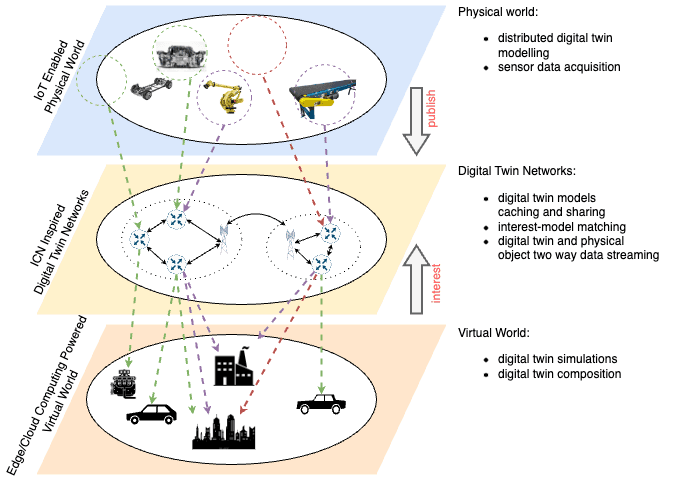
The Internet of Digital Twin Things (IoDT2) framework enables easy sharing of models and data across networks. Computation resources can dynamically be formed to execute simulations at edge, fog, or cloud level, allowing practitioners to focus on core models rather than complex software configuration.
Technical Innovation
Built on an Information Centric Network (ICN) inspired Digital Twin Centric Network (DTCN), our framework allows digital twin models, data, and compute resources to be published and located across networks easily, supporting applications in manufacturing, healthcare, and smart cities.
Key Use Cases
Construction Project Management
Real-time digital representations of construction projects to improve resource usage and performance tracking.
Earthquake Damage Simulation
Simulating earthquake impacts on infrastructure, particularly communication networks, to support better preparedness and response.
Multi-Modal Transport
Applying digital twin networks to urban transportation systems to reduce congestion and enhance sustainability.
Project Partners






Ontology Framework
Two-Tiered Ontology Framework
Top-Level Ontology
Basic Formal Ontology (BFO) with Common Core Ontologies (CCO)
- Strong support for interoperability
- Scalability
- Compatibility with IoT and real-time data
- Alignment with semantic web standards
Sub-Ontologies
IoT and Real-Time Data
SOSA (Sensor, Observation, Sample, and Actuator) Ontology with Web of Things (WoT)
Spatial and Geographic Information
GeoSPARQL for robust spatial data representation
Event and Temporal Data
OWL-Time Ontology for temporal concepts
Smart Applications and Devices
SAREF (Smart Applications REFerence) Ontology for smart applications and device interoperability